September 21, 2026 · 5 min
A bench in a walk-in shower: built, folding, or freestanding
Three kinds of bench go into showers, and they are not interchangeable. One is masonry, one hangs on the structure of the wall, and one just stands there.
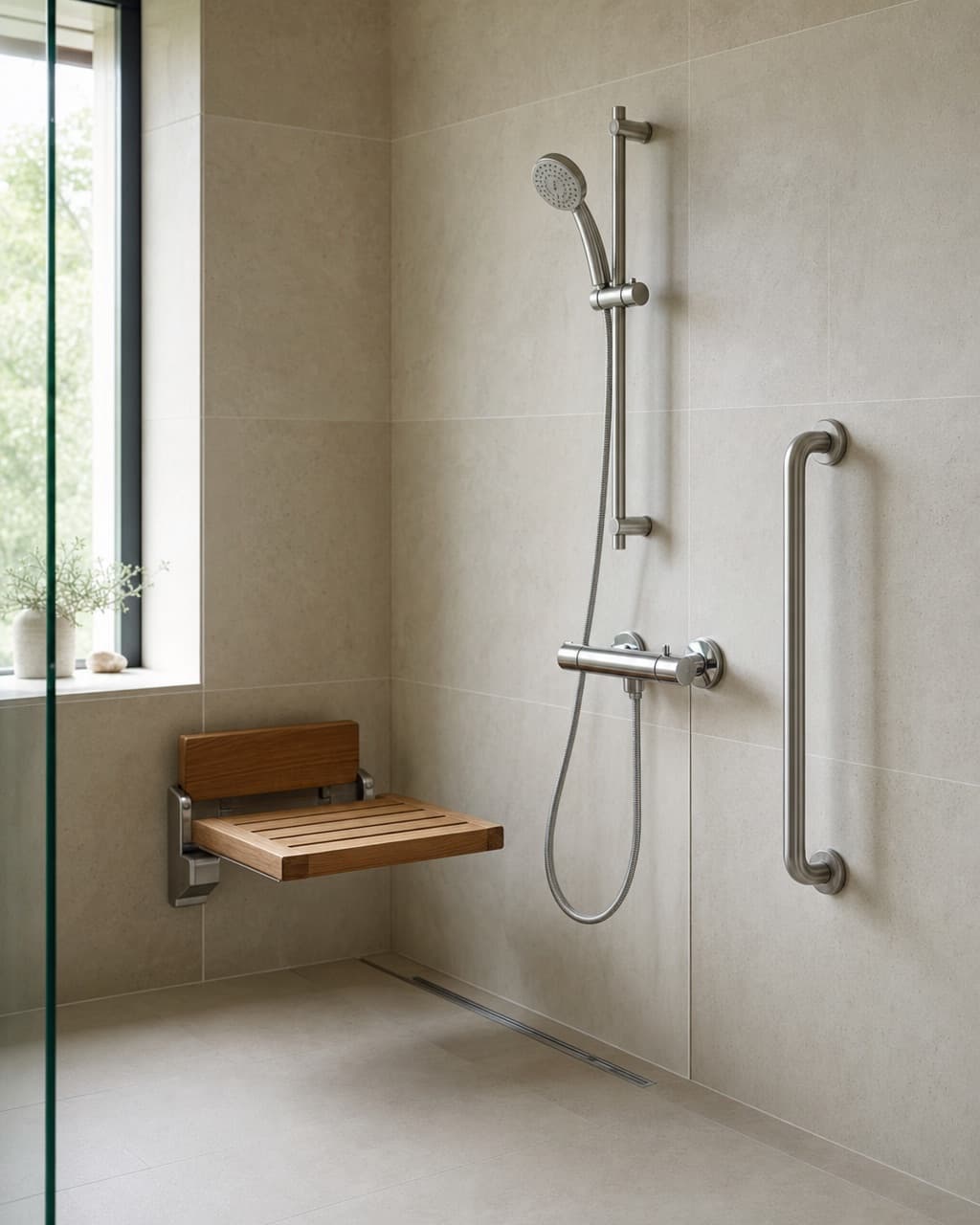
Four thousand four hundred searches a month look for a bench, which says something the galleries rarely do: a lot of people shower sitting down, or want the option. A seat is what lets someone wash seated, rest mid-shower, or steady a foot while washing it. That is the physical description, and it is reason enough. What matters is that the three kinds of bench are different objects with different requirements, and the right one depends on the room and the person.
The built bench is part of the shower, not furniture in it
A masonry or foam-core bench is built with the shower, waterproofed as one assembly with the walls and the floor, and tiled. Its top is sloped a few degrees so water runs off rather than pooling, and the membrane runs over it before any tile does. Done properly it is permanent and it will hold anyone. Done as an afterthought, with tile over bare blockwork, it is the first place the shower leaks.
The folding bench hangs on the structure of the wall
A wall-mounted folding seat carries a seated adult on a few fixings, which means those fixings must land in solid blocking installed between the studs while the wall is open. Tile and board alone will not hold it, for exactly the reasons that apply to grab bars. Folded up, it gives the floor back, which is why it suits a compact shower shared by a seated user and a standing one.
The freestanding stool, honestly considered
A teak stool or a plastic shower chair needs no blocking, no membrane and no installer, and for a household that wants a seat this month rather than after a remodel it is the practical answer. Its legs stand on a sloped, wet floor, and it holds still only as well as its feet grip. It is a real option and a different class of object, and the honest move is to say so rather than pretend the three are equivalent.
Where the bench goes decides whether it is used
A seat is used when the controls and the spray can be reached from it. That means the valve within reach of a seated arm, a handheld on a slide bar low enough to lift down, and the seat out of the coldest line of the spray but not out of the water entirely, all of which are ideas judged by year ten rather than by a photograph. A bench in the far corner, out of reach of everything, becomes a shelf. Watching the person shower once, or asking them to mime it in the empty room, settles the position better than any drawing, and it takes five minutes.
Dimensions worth settling in the drawing
Seat height near chair height, the height the person can stand up from, which is a thing to test on an actual chair rather than assume. Depth enough to sit on rather than perch. Clear space beside it if a helper or a transfer is part of the picture, which is one of the decisions the aging-in-place page puts before any fixture. Where published accessibility standards are being followed, their seat dimensions may apply, and how far such standards bind a private bathroom is covered in the ADA article.
Retrofitting a seat into a finished shower
Into an existing tiled shower, a folding seat can still go in if blocking can be reached or a backing solution suits the wall, and a freestanding stool always can. What cannot be added afterwards is the built bench, short of the remodel described in the remodel article. If a shower is being planned now, put the blocking in now, whatever the current plan for a seat: it costs least at the exact moment it seems least necessary.
Have the seat planned while the wall is still open
A bench is cheap to prepare for and awkward to retrofit. Tell us how the shower is used and we will place it in the drawing, not after the tile.