September 11, 2026 · 6 min
What a walk-in shower actually is, and what the name leaves out
The most searched term in this category names the entrance and nothing else. Everything that decides whether the shower works is left for you to specify.
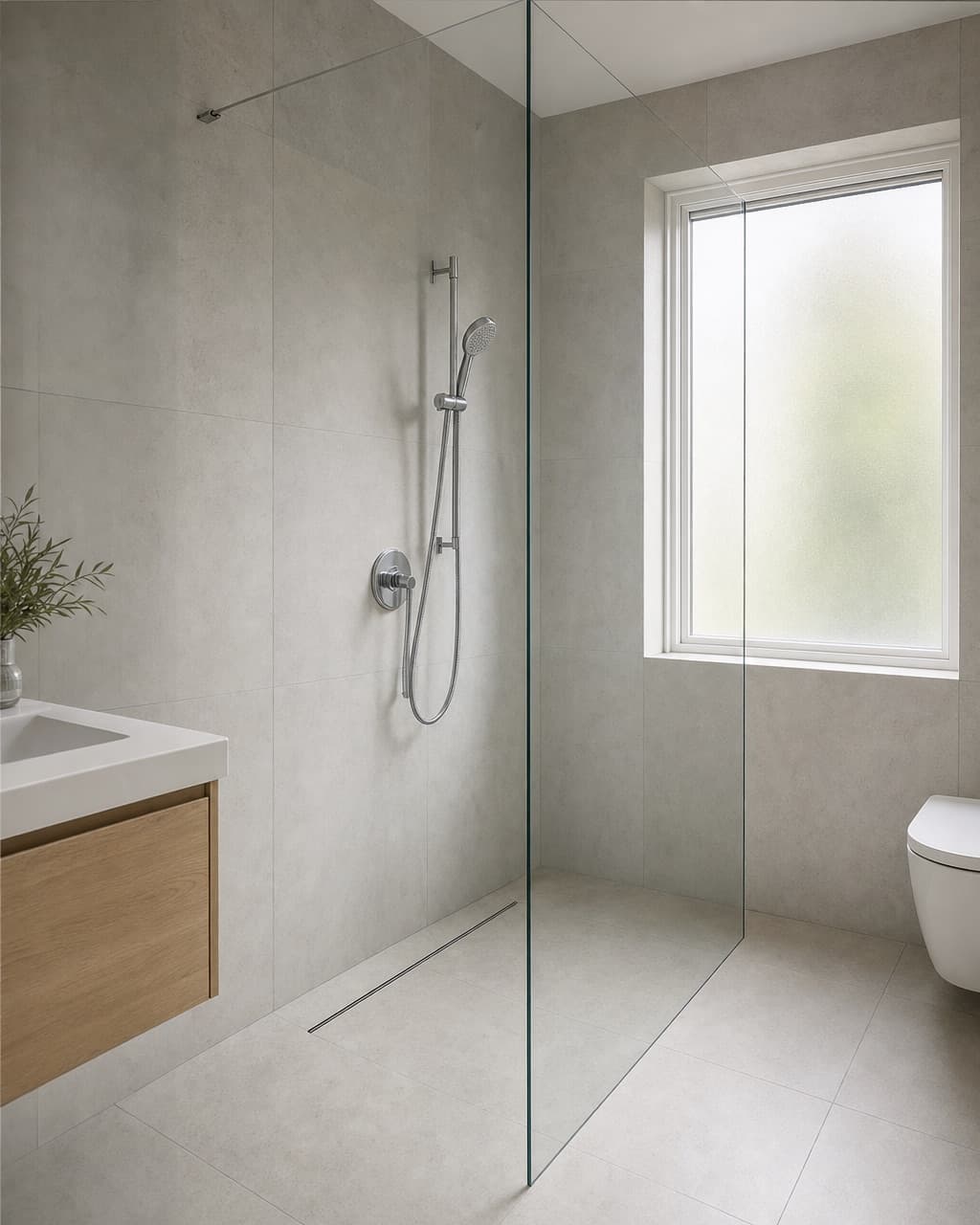
Sixty thousand five hundred searches a month use this term on its own, which makes it the largest query we have measured in the category, ahead even of the walk-in tub. It is also the vaguest. A walk-in shower is a shower you enter by walking: over a low curb or over nothing at all, rather than by climbing a tub wall or stepping up into a raised base. That is the whole definition, and it is a description of the entrance, not of the shower.
One name, two different builds
A curbed walk-in shower keeps a low upstand at the opening. The floor inside slopes to a drain, the curb holds the water, and the build stays above the existing subfloor. A curbless shower removes the upstand entirely, which means the shower floor has to start lower than the bathroom floor and still fall toward the drain. The first is finish work. The second reaches into the structure, and the difference between them is under the tile, not in the showroom.
It is not a walk-in tub
The two names are close enough that advertisers lean on the confusion. A walk-in tub is a deep bathtub with a watertight door: you sit in it, it fills, and it drains before the door opens, which is what that door actually changes. A walk-in shower has no door to wait behind and no depth to sit in. Someone who bathes may want the tub; someone who wants both is looking at the combination fixture and its compromises; someone who showers almost never wants either. The comparison, taken slowly, is on tub versus shower.
The parts you see
Tile or wall panels supplied as a kit, a glass panel or a curtain, a drain, a valve, a shower head, perhaps a handheld on a slide bar, perhaps a seat, perhaps a niche for the soap. Every one of these is chosen late in the job and photographed afterwards, which is why they dominate the pictures this query returns. None of them is where a walk-in shower succeeds or fails.
The parts you do not see
Underneath the tile there is a slope, built in mortar or preformed foam, and over that slope a bonded membrane, lapped up the walls and sealed at the drain. Tile is not waterproof and grout is not waterproof; the membrane is the shower. For a curbless build there is also a recess in the subfloor, and what that recess involves depends on the joists or the slab below, which is set out on the shower conversion page.
Who it genuinely suits
Someone who showers rather than bathes, whether standing or seated. A level entry leaves room for a seat, room for a second person to help, and room for a walker or a wheelchair if one is ever used. Those are physical properties of a floor with no step in it, and they are the honest reasons this layout is chosen. Someone who genuinely wants to soak is the one person a walk-in shower does not serve.
What it asks of a small bathroom
Water has to stay in the shower without a tub wall to stop it. That is done with layout, with slope, with glass, or with generous distance, and in a compact room it is a real design constraint rather than a detail. A fixed panel that blocks the reach to the controls, or a spray aimed at the doorway, is the kind of mistake that is cheap on paper and permanent in tile.
How to go about getting one
Decide how it will be used before deciding how it will look: standing or seated, curb or curbless, who else uses the same bathroom. Then have the room surveyed, because the drain position and the floor structure decide what is possible. The full sequence of the work, in the order it has to happen, is in the installation article, and it is a better shopping list than any gallery.
Tell us how the shower will be used, and we will name the build
Standing or seated, curb or no curb, alcove or corner. The answers decide the work, and we put them in writing before anything else.
Senior Bath Quote converts bathtubs to curbless showers, installs walk-in tubs, and fits grab bars and other safety modifications. One written quote, no same-day discount, no in-home close.